Deepfakes are no longer a far-off possibility. They are a real and current threat! In 2025 an estimated 8 million deepfakes were shared. This is up from just 500,000 in 2023, a 1,500% increase. The pressure to detect AI-generated content quickly and reliably has never been greater. This is the question we set out to answer.
Inside the experiment: What did we do?
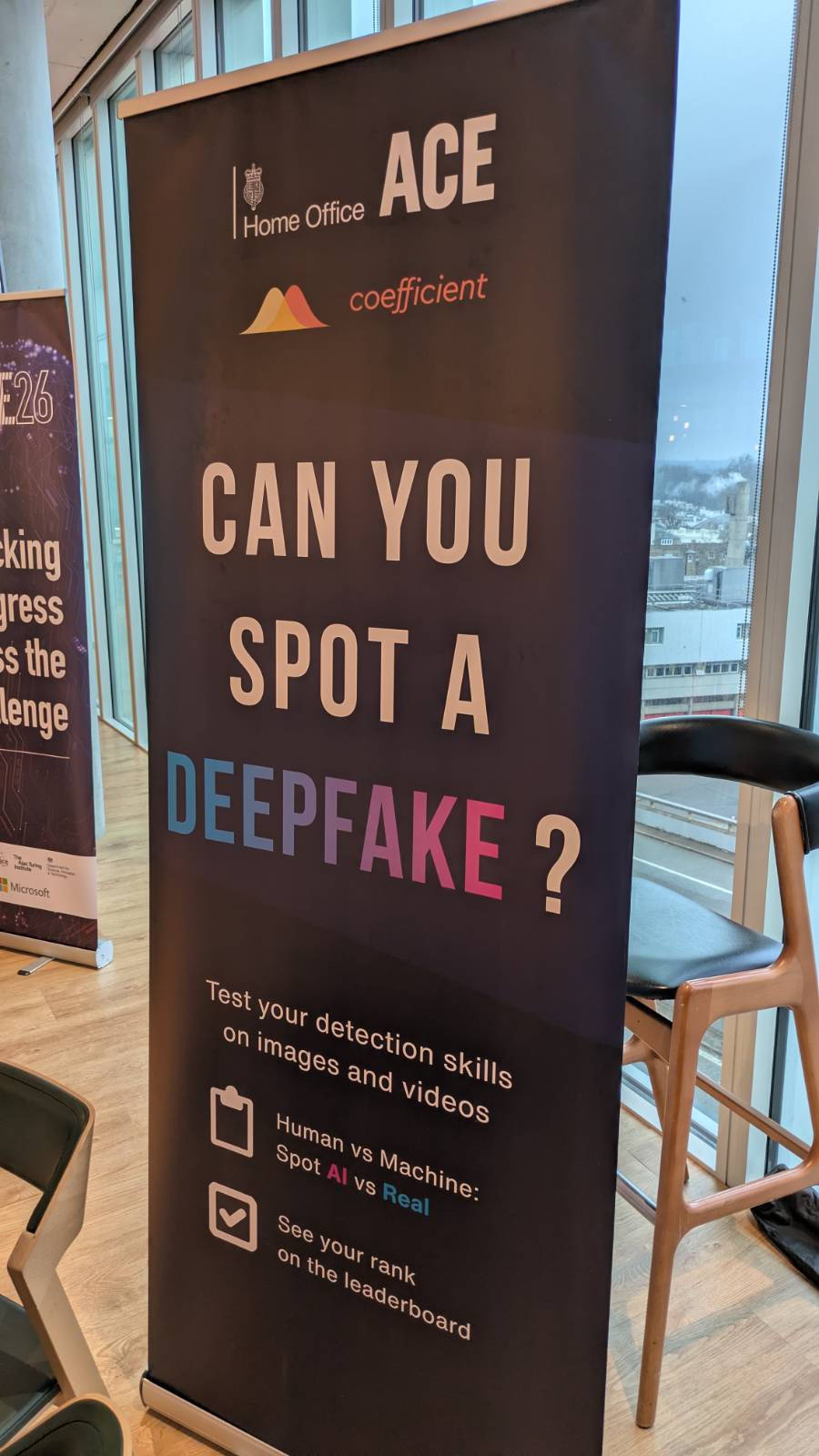
We were tasked with designing, building and delivering a deepfake detection hackathon on behalf of the Home Office, under the ACE programme. The event was designed to simulate real-world operational conditions. Participants applied detection techniques against a curated dataset of adversarial deepfake content. This spanned across image, video and audio, specifically created for this event.
All activity took place within a secure, air-gapped environment, with live submissions, real-time evaluation and a dynamic leaderboard. This wasn’t a theoretical exercise. It was a practical test of how detection capabilities perform under pressure.
Here’s what happened when real people met deepfakes:
• They performed strongly when it came to detecting fully synthetic media, but there were clear weaknesses in partial or subtle manipulations.
• Image-based content was consistently the hardest, with the highest undetected rates compared to video and audio.
• Certain techniques, such as lip syncing and scene manipulation, proved particularly challenging and remained unsolved in many cases.
• A notable number of assets (~6.7%) were not solved by any team, highlighting genuine gaps in current detection capability.
We also saw interesting behavioural insights. For example, a split between teams optimising for volume versus accuracy. This then influenced scoring outcomes and highlighted the importance of scoring design.
Where do we go from here?
The realism and operational relevance of the scenarios was key when it came to feedback regarding the event. The participants valued working against deepfake content in a setting which replicated real-world investigative challenges. They also found ‘inverse’ scenarios, where they looked for real content amongst synthetic noise, particularly valuable.
The deepfake challenge is widespread and urgent. This was reflected with the level of engagement at the event, with participation across government, academia, finance and international partners. It showed that detection capabilities are improving, but there are still clear gaps. These are particularly obvious when it comes to subtle, high-quality manipulations and image-based content.
Further innovation is needed in more robust and forensic approaches. This was clear with the teams relying heavily on artefact-based detection such as upscaling and prompt traces.
And finally, the event demonstrated this problem is not purely technical. Human analysis is still key, and detection models combined with investigative tradecraft remain critical.